
The E-Z Storage Journal
Storage know-how for the Gulf Coast – Page 2
Hurricane prep, sizing guides, and practical tips for storing boats, RVs, trailers, and everything else, from our team in Hitchcock, TX.
Hurricane Season Boat & RV Storage on the Texas Gulf Coast: A Complete Prep Guide
Atlantic hurricane season runs June 1 through November 30. Here is exactly how Galveston County owners prep, strap down, and store boats, RVs, and trailers so they come through a storm intact.
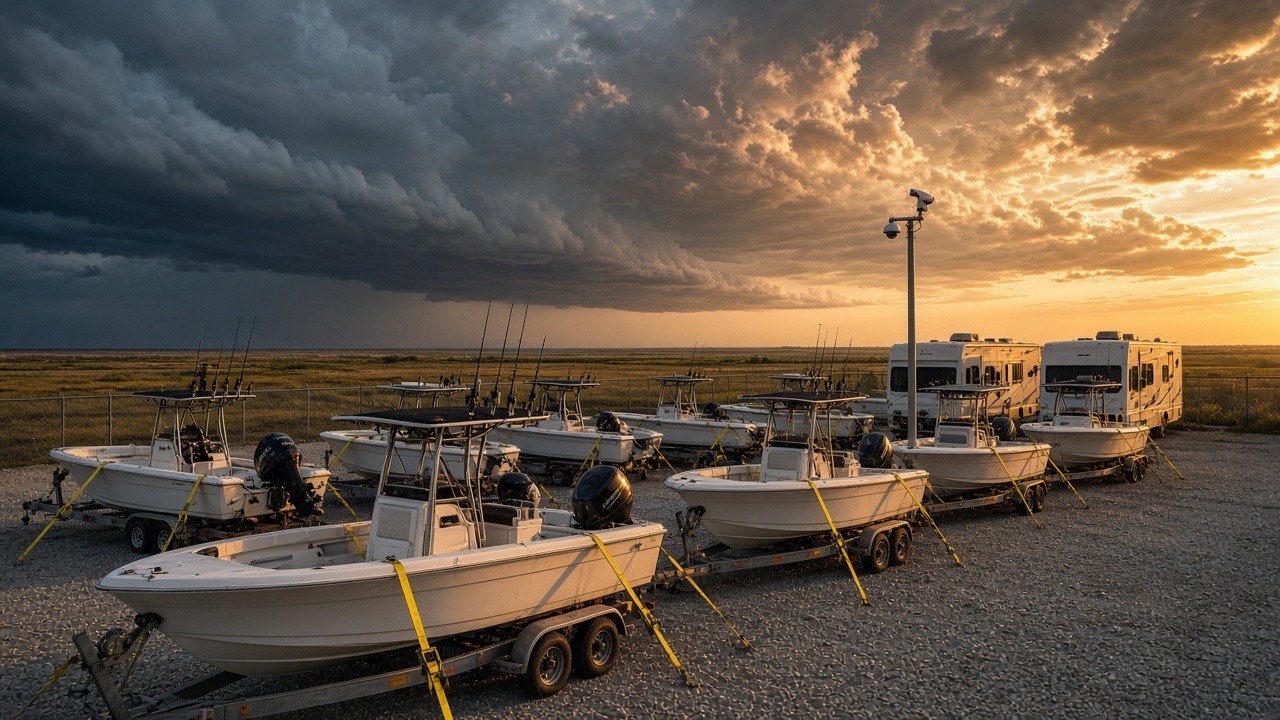
The short answer: the best way to protect a boat, RV, or trailer during a Texas Gulf Coast hurricane is to get it out of the water and off your driveway, onto a secured, monitored storage lot, with the vehicle strapped down, loose gear removed, and its condition documented for insurance. The rest of this guide walks through exactly how to do that, step by step, and when to start.
When is hurricane season on the Texas coast?
The Atlantic hurricane season officially runs from June 1 through November 30. For Galveston County and the communities along FM 2004, such as Hitchcock, La Marque, Texas City, and Santa Fe, the most active stretch is typically mid-August through the end of September, when Gulf water temperatures peak. That's why storage lots across South Houston start filling up in late summer, and why the owners who plan in June rarely end up scrambling in September.
Why storing your boat on land beats riding it out at the dock
A boat left in a slip during a hurricane is exposed to storm surge, wave action, and collisions with other vessels that break loose. Even a well-tied boat can be damaged as pilings fail or docks lift off with the surge. A trailerable boat on solid ground avoids all three hazards. Its main remaining risks are wind and flying debris, and both are far easier to manage with straps, cover removal, and a secure location.
The same logic applies to RVs and travel trailers. Parked next to a house, they catch wind like a sail and can be struck by falling trees, fences, and roofing. A level, open storage lot with no overhanging trees and a perimeter fence removes most of those threats.
Your 72-hour hurricane storage checklist
Use this as a timeline once a storm enters the Gulf and the forecast cone includes the upper Texas coast.
72 hours out: secure your spot and your paperwork
- Reserve storage now. Call your facility before the storm is named; spaces disappear fast once local news starts tracking it. E-Z Storage can be reached at 713-702-8451.
- Review your insurance policy. Confirm whether named-storm damage is covered and whether your policy requires a written hurricane plan. Many marine policies do.
- Gather documents. Put the title, registration, insurance card, and a recent photo of the hull ID number or VIN into a waterproof bag that travels with you, not the vehicle.
48 hours out: prep the vehicle
- Remove everything loose. Biminis, canvas tops, cushions, electronics, fishing rods, antennas, and outriggers become projectiles in high wind. On RVs, retract awnings, slide-outs, and satellite dishes.
- Fill or empty fuel deliberately. A full fuel tank reduces condensation and keeps the boat heavier; check your engine manual and add stabilizer. For RVs, shut off propane at the tank.
- Disconnect batteries or switch them off to prevent electrical shorts if water intrudes.
- Pull the drain plug on boats stored outdoors so rainwater can escape rather than pooling and overloading the trailer.
- Tape and seal. Use marine-grade tape over windows, vents, and hatches to keep wind-driven rain out.
24 hours out: tow, park, and strap down
- Tow to storage in daylight. Highways like I-45 and FM 2004 clog quickly during evacuations, so move early.
- Chock the wheels and lower the tongue jack onto a solid pad. Letting a little air out of trailer tires lowers the center of gravity and reduces bounce.
- Strap the boat to the trailer at the bow eye and both transom eyes, then use ground anchors where the facility allows.
- Document everything. Walk around the vehicle with your phone recording video, narrating the date and condition. Take close-ups of the hull, tires, and any existing damage.
Outdoor parking vs. container storage: which do you need?
Not everything you own should ride out a storm in an open parking space. Here's how to decide:
| What you're storing | Best option | E-Z Storage price |
|---|---|---|
| Jet ski, small bass boat, utility trailer | Small parking space (10×25 ft) | $55/month |
| Center-console boat, RV, fifth wheel (up to 35 ft) | Large parking space (12×50 ft) | $75/month |
| Outboard motors, electronics, cushions, fishing gear | 8×20 ft storage container | $85/month |
| Classic car or vehicle you can't risk to wind | Car storage unit | $100/month |
| Documents, photos, heirlooms, anything humidity-sensitive | Climate control unit | $195/month |
A common setup for Galveston County boat owners is a large parking space for the boat itself plus a shared container for everything stripped off it before the storm. Everything ends up in one place, and reinstalling gear after the all-clear takes an afternoon instead of a weekend.
What to look for in a hurricane-ready storage facility
Not all storage lots are equal when the wind picks up. Before you commit, ask these questions:
- How is the site secured? Look for a perimeter fence, video surveillance, and staff who actually walk the lot. At E-Z Storage, staff do daily visual inspections in addition to camera coverage.
- Can I get in when I need to? Storms don't keep business hours. 24/7 access means you can drop off at 5 a.m. before evacuation traffic, or check on your boat the moment roads reopen.
- Are the containers rated for storms? E-Z Storage containers are built for high structural resistance and are guaranteed hurricane-proof, keeping contents dry through extreme weather.
- Is it inland of the surge zone? A facility on the mainland side of Galveston Bay, like ours at 5420 FM 2004 in Hitchcock, puts distance between your boat and the worst of the surge.
- Is there a rinse station? After a storm, flushing salt spray and debris off hulls and undercarriages fast prevents corrosion. We have one on site.
After the storm: bringing your boat or RV back
Wait for local officials to declare roads safe before heading out. When you arrive, photograph the vehicle before touching it so your before-and-after record is complete for any claim. Check tire pressure, inspect straps for fraying, and look for water intrusion around hatches and windows. Rinse off salt and grit, reconnect batteries, and run engines and generators for a few minutes before towing.
If you left gear in a container, reinstall electronics only after confirming the boat's wiring is dry.
Plan now, not when the cone shifts
The owners whose boats and RVs come through hurricane season without a scratch rarely got lucky. They had a spot reserved, a checklist ready, and a plan to move early. If you're in Hitchcock, Galveston, Texas City, League City, or anywhere in South Houston, request a quote or call us at 713-702-8451 to lock in your space before the next storm is named.
Frequently asked questions
When should I move my boat to storage before a hurricane?
Aim to have your boat on land and strapped down at least 24 hours before forecast landfall, and reserve your storage space 72 hours out or earlier. Evacuation traffic on I-45 and FM 2004 makes last-minute towing risky.
Is it safer to leave my boat in the water or on a trailer during a hurricane?
For trailerable boats, on a trailer at an inland storage lot is generally safer. Boats in slips face storm surge, wave damage, and collisions with other vessels; on land, wind and debris are the main risks and can be managed with straps and gear removal.
How much does boat or RV storage cost in Hitchcock, TX?
At E-Z Storage in Hitchcock, a 10×25 ft parking space is $55/month and a 12×50 ft space for RVs and larger boats is $75/month. Storage containers start at $85/month.
Should I remove the drain plug from my boat in storage?
Yes, for boats stored outdoors on a trailer. Removing the drain plug lets rainwater escape instead of pooling in the hull, which can overload the trailer and damage the boat.